Railway Surveying
Precision surveying for railway projects. El-Eman Office provides infrastructure surveying services.
Coordinates and curves in design
A railway is not just a straight path; it is a series of straights and horizontal and vertical curves. Straights are joined by circular curves, with transition curves between them in which the curvature changes gradually so passengers do not feel a sideways jolt. The outer rail is raised on a curve by a calculated amount called cant, to balance the centrifugal force. All these elements are set out on the ground from coordinate tables so that the centreline can be rebuilt accurately at any time.
Adjusting and maintaining the track
After the rails are laid, the track geometry is measured to confirm it matches the design. Measurements include the gauge between the rails, longitudinal level, twist, cant on curves and horizontal alignment. Measuring vehicles fitted with sensors survey the track quickly, alongside precise survey instruments used as the reference. Once in service, track geometry changes under load and vibration, so periodic surveys identify what needs adjustment, which is known as corrective maintenance.
- Critical places such as bridges, tunnels and switches need closer monitoring.
- Temperature changes in long rails are taken into account when adjusting.
- A time-based record of measurements is kept to track the trend of deterioration.
Survey challenges specific to railway works
Railway projects are long and involve many contractors, so everyone must rely on one unified control network to ensure that work built in different sections fits together. Crossings with roads and utilities require coordination with several bodies. Works sometimes take place near operating lines, which calls for strict safety procedures and coordination of traffic closures. In urban areas there is the added burden of managing vibration and the effect of construction on neighbouring buildings.
- Establish a unified, stable control network along the route.
- Set out the track axes from the coordinate tables and approve them before construction.
- Measure the track geometry after laying and before handover.
- Carry out periodic surveys for monitoring and maintenance after operation.
Surveying around live traffic
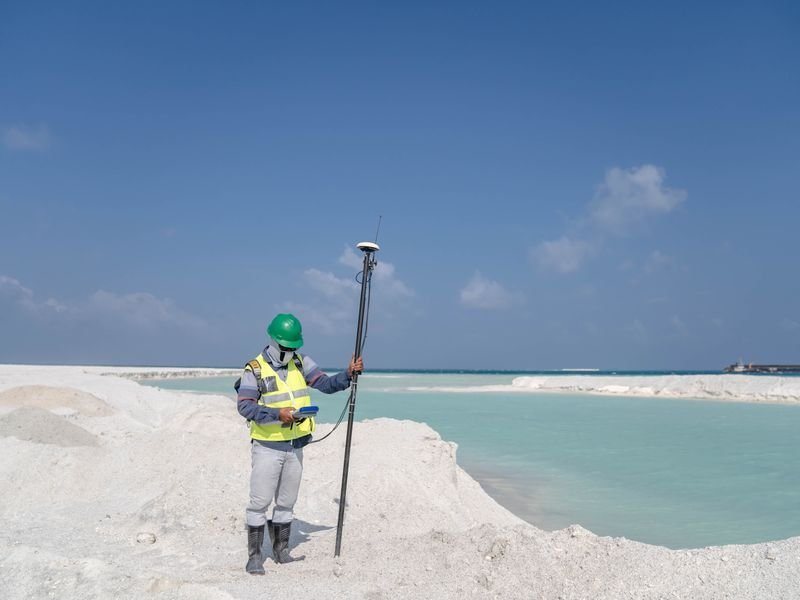
Measurements on existing lines require strict coordination with the operator, since entry to the track is allowed only with permits, at set times and under supervision by specialists. The team uses instruments that measure from outside the danger zone as far as possible, or dedicated measuring vehicles. High-visibility clothing and warning procedures are followed. It is important to prepare the work plan in advance to minimise time on the track, and to record data in an organised way that allows it to be reviewed without re-measuring.
Frequently asked questions
Why do transition curves matter?
They prevent a sudden change in sideways force on entering a curve, which improves passenger comfort and reduces loads on the track.
Is the same accuracy required in every part of the project?
No. Rail geometry needs higher accuracy than earthworks or grading, and each stage is given its own accuracy level.
How are bridges on the line monitored?
With periodic measurements of levels and deflections and possibly fixed sensors, compared with the limits set by the structural engineer.